 winkylabs llc
winkylabs llc
winkylabs llc
Coding agents make one person fast. What they don't do on their own is leave a record a reviewer can trust, or a bill anyone can see. This is the practice that grew across the projects here to fix both, and the numbers it produced. The long-form version is the blog post Keeping the receipts (2026-08-17).
Every repository carries a CLAUDE.md the agent reads
before it does anything: hard rules first (data-safety guardrails,
the one source of truth for each fact, "never push", what is out of
scope), then the project's non-obvious conventions, then banned
patterns with before/after examples. Projects mandate a changelog
entry per change, structured logging only, and a committed phase
plan before implementation. The contract is what
makes a fresh session cheap: the agent starts cold and already
knows the rules.
Three files per project. TODO.md is intake.
PLAN.md is the live plan, updated as work happens, with
a rule against ticking a box before the exit criteria are met.
DONE.md is the timeline of what shipped, dated, original
wording kept. Review audits (REVIEW.md) are worked to
closure with a written resolution or a written "won't do" per
finding: hoppr's audit ran as milestones and grew the test suite
along the way; drumpy's closed every finding and shrank its largest
module.
An agent can't see the app, so each project builds a channel it can read instead:
The agent's transcript is the "how" behind every commit, and the
tool prunes it after thirty days. So the end of every session runs
a wrap-up that archives the raw transcript into the repository,
derives a readable thread from it, and refreshes a
stats.json with commits, lines, tokens and list-price
cost per day. Each commit carries a trailer naming the session it
came from, so a line of code can be blamed to the conversation that
wrote it. A portable playbook and a shared library carry the
practice to every live repository; a private service indexes all
of it.
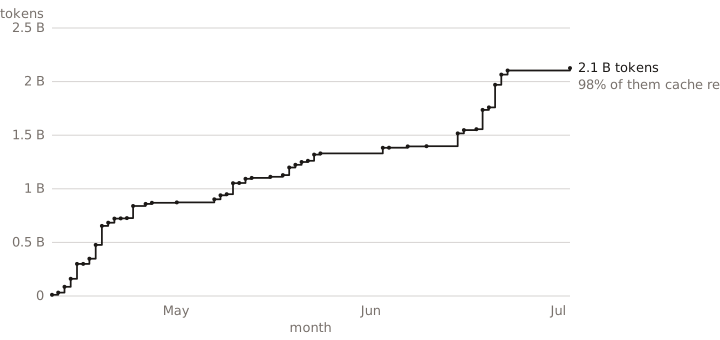
Once the sessions were in the repository, the total was a sum away, and the shape of it was the surprise: on drumpy 98% of all tokens are cache reads. Long sessions are expensive because every turn re-reads the whole conversation, not because the model writes a lot. A turn at 500 k of context costs about five times a turn at 100 k, so the lever is context × turns.
The practice changed accordingly: one item of work per session, commit, wrap up, end; the next unit starts cold because the plan and the log already say where things stand; big reads go to subagents whose context dies with them. Measured on lifecast before and after the change, per commit and per line so the app maturing doesn't get credited to the discipline:
| lifecast | sessions | turns / commit | avg context | tokens / commit | tokens / 100 lines |
|---|---|---|---|---|---|
| before | 6 | 13 | 280 k | 3.7 M | 2.9 M |
| after | 11 | 10 | 140 k | 1.4 M | 1.6 M |
From the blog post; tokens at list price from the per-turn usage in the transcripts.
Per commit that is a 2.7× drop. Turns per commit fell a little; the context under each turn fell by half, and ending the session is the one lever that pulls both.
| drumpy | |
|---|---|
| commits | 290 |
| lines of code | 47 k |
| tokens, all sessions | 2.2 B |
| of which cache reads | 98% |
| agent turns | 10 k |
| list-price cost | ~$1.6 k |
| sessions archived | 93 |
drumpy docs/sessions/stats.json, generated
2026-09-01, counting each streamed assistant message once. The
dollar figure is a list-price estimate from a hand-maintained
pricing table, not what a subscription bills.